There is one fundamental problem with planning a New England fall road trip.
The trees have not read your itinerary.
You can book the flights, reserve the inn, rent the car and carefully circle the first week of October on a calendar. The maples remain under no contractual obligation whatsoever to turn red on Tuesday.
Peak fall color moves across New England rather than arriving everywhere at once. It generally begins in the north and at higher elevations, then works south and towards the coast. Temperature, rainfall, wind, elevation and the preceding summer can move the show forward, hold it back or strip the best leaves from a hillside overnight.
That makes the perfect New England foliage road trip less about finding one supposedly magical date and more about building a route with room to chase the color.
For a seven-day trip, there is an excellent way to do it.
Start in Boston, head north-west into Vermont, cross the White Mountains of New Hampshire, reach the western mountains of Maine, then turn south and work your way back towards Massachusetts.
In a good year, you’re effectively travelling with autumn.
And if the foliage refuses to cooperate, you’re still driving through covered bridges, mountain passes, white-steepled villages and towns apparently designed by a committee whose brief was simply “make it look more New England.”
The route at a glance
- Best window: Roughly late September to mid-October. For this particular route, the first two weeks of October offer the best historical compromise — but there is no reliable fixed “peak week”, so check current foliage reports before and during the trip.
- Start and finish: Boston, Massachusetts.
- Route: Boston → Woodstock, Vermont → Stowe → Lincoln, New Hampshire → Kancamagus Highway → North Conway → Rangeley, Maine → Bethel → Boston.
- Time: Seven days.
- Driving: Roughly 800–900 miles depending on detours.
- The rule: Don’t try to see all six New England states in seven days. (Well, You can…You can also spend a week’s holiday staring at the back of a Subaru).
This itinerary concentrates on Vermont, New Hampshire and western Maine, where mountain elevation, forest density and excellent roads give you several chances of finding serious color. Massachusetts provides the natural gateway from Boston.
Connecticut and Rhode Island can wait for another trip — and, conveniently, their foliage often does too.
When does New England fall foliage peak?
There is no single New England peak.
That’s the first thing to understand before booking anything.
Northern New England usually changes first. New Hampshire says the Great North Woods begins showing fall color around mid-September, with the White Mountains following from late September. Its official foliage information is based partly on historical patterns, but weather makes precise forecasting impossible.
Maine follows the same broad north-to-south progression. Northern Maine typically peaks from the final week of September into the first week of October, while central Maine and the western mountains tend to peak around Indigenous Peoples’ Day weekend. Coastal and southern Maine are generally later, from mid-October onwards.
That progression is why this itinerary doesn’t make the common mistake of trying to combine the mountains of Vermont and New Hampshire with coastal Maine as though the leaves operate on a synchronised timer.
They don’t.
For 2026 specifically, don’t assume the historical calendar will be exact. Maine’s September 16 report still rated color change as low in the western and northern parts of the state and very low elsewhere, with very little leaf drop statewide.
The sensible strategy is therefore to choose your general travel window months ahead, but choose your precise day-to-day route as late as practical.
Autumn rewards commitment.
Peak foliage rewards indecision.
Day 1: Boston to Woodstock, Vermont
Sleep: Woodstock
Collect the car and get out of Boston.
That may sound dismissive of one of America’s great cities. It isn’t. Boston deserves several days of its own.
Those days should not come out of your foliage week.
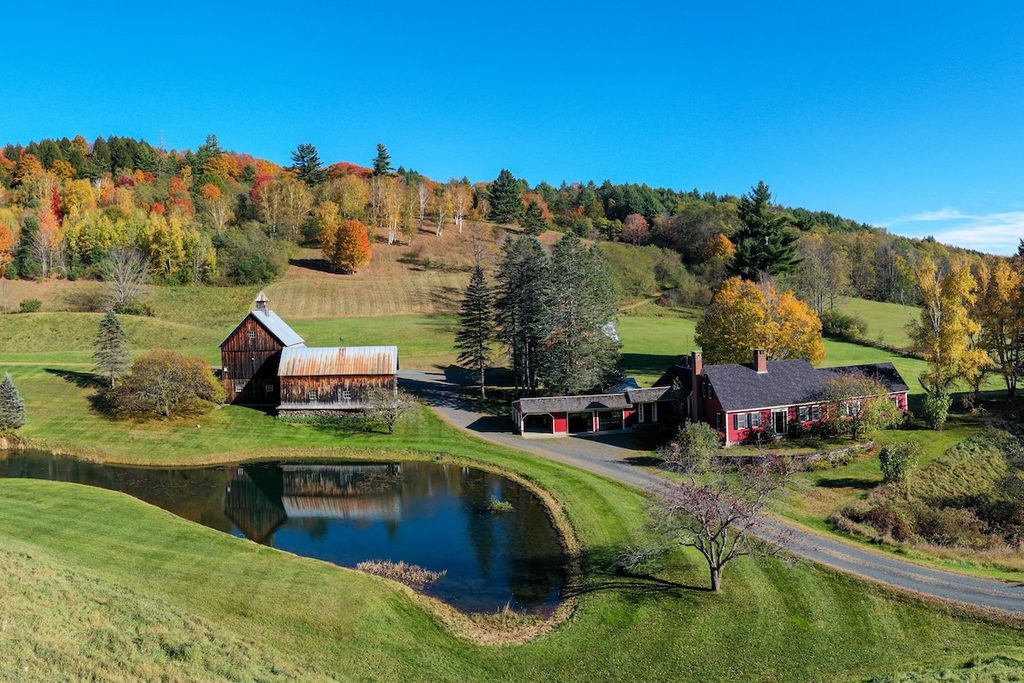
The aim today is Vermont, and specifically Woodstock, one of those New England towns that looks suspiciously like the stock photograph websites have been conspiring to create expectations around.
Don’t optimise the drive entirely for speed. Once you’re clear of metropolitan Boston, the point is to begin exchanging interstates for smaller roads.
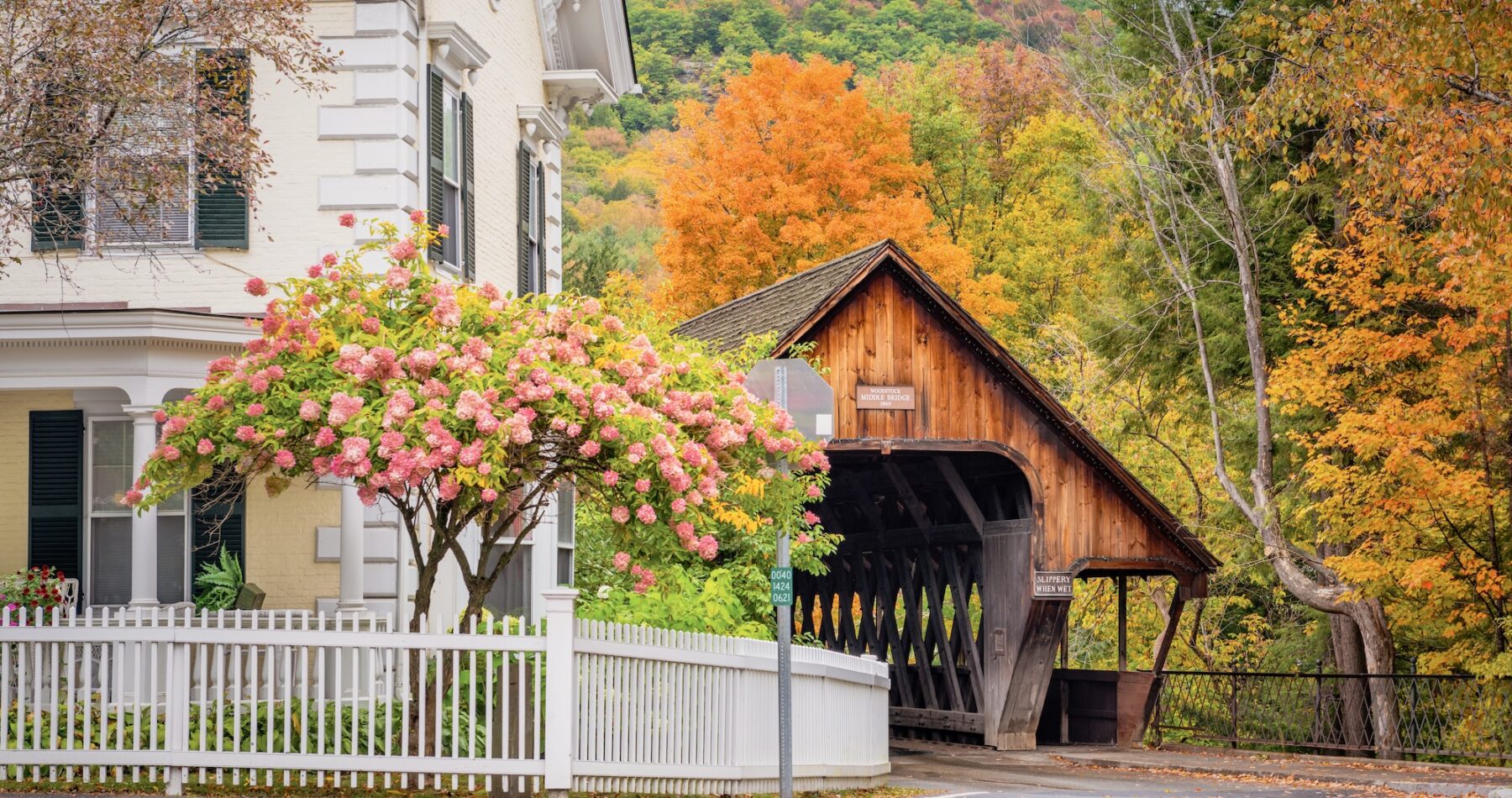
Woodstock makes a particularly good first base because the town provides what people imagine when they picture Vermont in fall: historic buildings, surrounding hills, country roads, farms and covered bridges.
But don’t spend the entire afternoon collecting evidence that Vermont has church steeples.
Get out of town.
Drive some of the smaller roads through the surrounding countryside. Look for working farms, stone walls, old barns and patches of forest rather than treating foliage as something that exists only at designated scenic overlooks.
If you’ve arrived during good color, this is also the moment to learn the first law of New England foliage travel:
A road does not have to be famous to be spectacular.
Some of the best stretches will be roads you hadn’t heard of that morning.
That’s why you came by car.
Day 2: Woodstock to Stowe
Sleep: Stowe
Today is deliberately short on compulsory mileage and long on opportunities to wander.
Head north through central Vermont towards Stowe, but resist the urge to treat the destination as the entire point.
Route 100 should form the backbone of the journey north. Running through the Green Mountains, it is one of Vermont’s classic foliage roads and links a succession of mountain towns and resort areas.
Don’t treat it as a road to complete quickly. Use it as the day’s organising principle and detour when the color gives you a reason.
Vermont is exceptionally good at turning an ordinary drive between two towns into three hours of stopping.
A red barn appears against a yellow hillside.
Stop.
A covered bridge appears.
Stop.
A farm stand offers cider doughnuts.
This is technically not a foliage emergency, but stop anyway.
The broader Stowe area gives you access to some of Vermont’s classic mountain scenery. Depending on conditions, use the afternoon for local roads and viewpoints rather than trying to accumulate destinations.
If the higher elevations are already past peak, look lower.
If the valleys are still mostly green, climb.
That ability to change elevation is one of the great advantages of a mountain foliage trip. A few hundred metres can sometimes make the difference between “pleasantly autumnal” and “somebody has turned the saturation slider up irresponsibly.”
Stowe is popular in fall for a reason, which also means accommodation can become expensive and traffic can become tedious.
Book the bed well ahead.
Remain emotionally flexible about everything else.
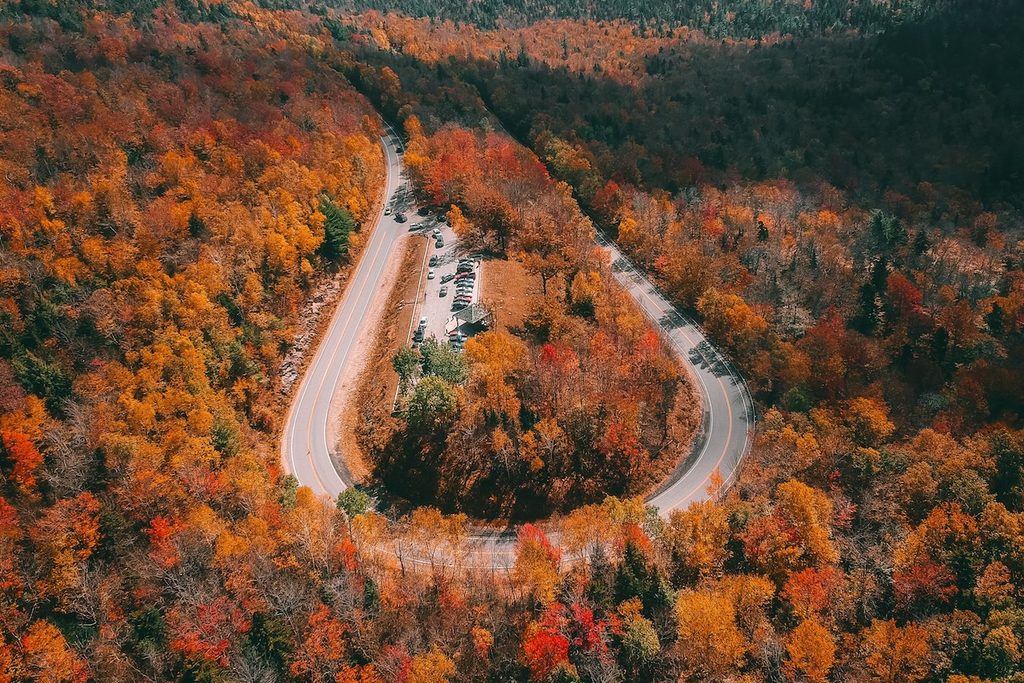
Day 3: Stowe to the White Mountains
Sleep: Lincoln, New Hampshire
Today you cross from Vermont into New Hampshire and position yourself for the most famous foliage road of the trip.
The White Mountains are one of New England’s great autumn landscapes, and their changing elevation makes them particularly useful when you’re hunting color rather than merely following dates on a calendar.
Make Lincoln your base.
The temptation will be to arrive and immediately attack the Kancamagus Highway.
Don’t necessarily do it.
If the weather is poor or you’ve arrived late, save the main event for tomorrow morning. Autumn color is dramatically better with decent light, and one of America’s finest scenic roads gains little from being driven at dusk behind a convoy of brake lights.
Use the afternoon instead for the Lincoln and Franconia Notch area, depending on conditions.
And check tomorrow’s weather before bed.
The Kancamagus isn’t going anywhere.
Half of Massachusetts might be heading there, however.
Day 4: The Kancamagus Highway to North Conway
Sleep: North Conway
This is the big one.
The Kancamagus Highway — New Hampshire Route 112 between Lincoln and Conway — runs for about 34.5 miles through the White Mountain National Forest.
On an empty road, New Hampshire tourism authorities say it can be driven in about 45 minutes.
In peak foliage season, they warn it can take two to three hours with traffic. There are no gas stations along the 34.5-mile stretch, and mobile coverage is minimal or nonexistent in places.
Which tells you almost everything you need to know.
Fill the tank.
Download the map.
Go early.
Some recreation sites and trailheads along the highway charge a day-use fee, so check current White Mountain National Forest requirements before setting out. Qualifying federal recreation passes are accepted at covered sites.
And do not plan anything important for 11.15am on the assumption that Google says North Conway is 55 minutes away.
The Kancamagus climbs through forest and mountain country with overlooks, trailheads, picnic areas and river access along the way. The road itself is the attraction.
Take your time at the legitimate pullouts rather than stopping somewhere stupid because you’ve just seen The Most Orange Tree In New Hampshire.
It will not be the last orange tree.
The highway eventually drops towards Conway and North Conway on the eastern side of the mountains.
If you still have energy, explore the Mount Washington Valley.
Crawford Notch is another superb drive, but it deserves enough daylight to enjoy properly rather than being bolted onto the end of an already full Kancamagus day.
But don’t turn the day into a competition.
A foliage road trip should contain periods during which absolutely nothing productive happens.
Sit somewhere.
Drink something warm.
Look at a mountain.
You’ve travelled thousands of miles to watch leaves die beautifully. It would be unfortunate to become too busy to see them.
Day 5: North Conway to Rangeley, Maine
Sleep: Rangeley
Now head into western Maine.
This is where the itinerary becomes particularly useful.
Many New England road trips automatically send travellers from New Hampshire straight towards Portland or Bar Harbor. Both are excellent destinations, but the Maine coast usually reaches peak color later than the northern and western mountains.
Rangeley keeps you in mountain country.
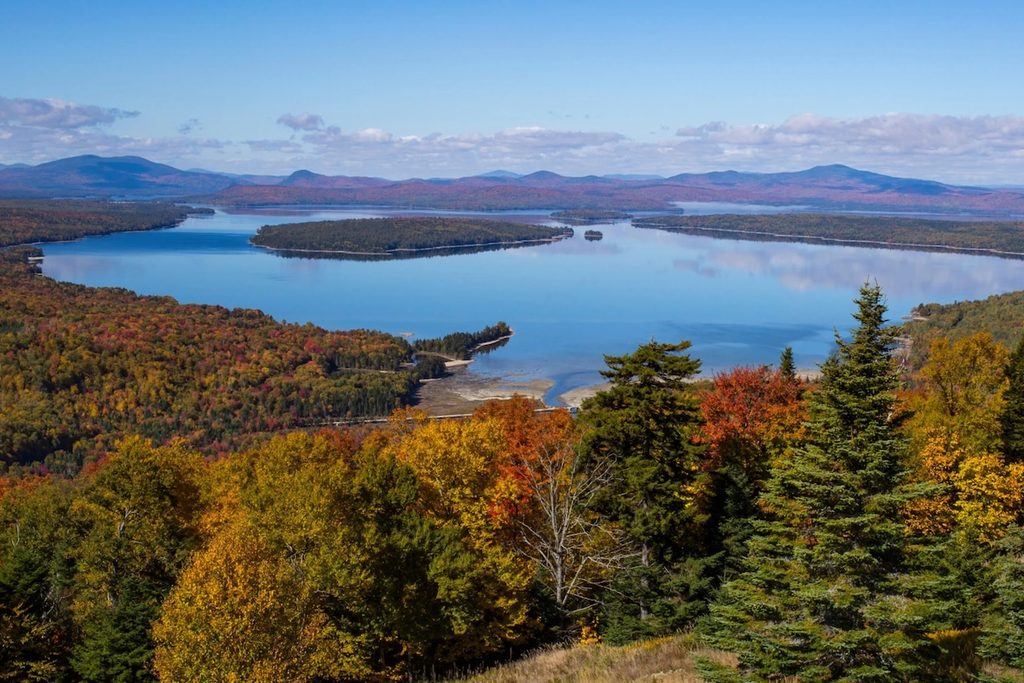
And it is magnificent road-trip country: forests, lakes, ridges and long stretches where the landscape feels considerably larger and wilder than the village-and-farm version of New England you’ve just driven through.
Once you’re in the Rangeley region, make the Rangeley Lakes National Scenic Byway part of the day rather than simply driving to your hotel.
The route follows Routes 17 and 4 through lake-and-mountain country, with the Height of Land overlook on Route 17 providing the signature view across Mooselookmeguntic and Upper Richardson lakes.
This is another day when the direct route is not necessarily the correct route.
Check Maine’s current foliage report before leaving North Conway. If western Maine is firing, give it the day it deserves. If conditions are better farther south, adjust.
And keep the fuel tank comfortably above empty.
Rural New England is not the place to discover that your rental car’s “37 miles remaining” estimate was written by an optimist.
Day 6: Rangeley to Bethel
Sleep: Bethel
This is the shortest-looking day on the itinerary and potentially one of the best.
The western Maine mountains offer exactly what a good foliage trip needs near the end: flexibility.
Rather than charging south, spend the morning around Rangeley and the Rangeley Lakes Scenic Byway before working towards Bethel.
Lakes matter here.
A forested mountain is impressive.
A forested mountain reflected in a lake has understood marketing.
Look for viewpoints where water, forest and elevation combine, and give yourself permission to take smaller roads when conditions and weather make them worthwhile.
Once around Bethel, Route 26 through Grafton Notch gives you another excellent option if daylight and foliage conditions allow.
The Grafton Notch Scenic Byway runs north from the Bethel area through mountain country towards the New Hampshire border, with roadside scenery, turnouts and access to Grafton Notch State Park.
It is the sort of drive that works particularly well late in a foliage trip: enough scenery to justify itself without requiring you to turn the day into a major hiking expedition.
Bethel then gives you a comfortable final night before returning to Boston.
By this stage, something else should have happened.
You should have stopped caring quite so much about whether the foliage is officially “peak.”
This is a surprisingly important development.
The internet encourages travellers to think there is a 48-hour period in which every tree in New England simultaneously reaches Pantone perfection.
Real autumn is messier.
One hillside is brilliant while another is green. A valley is glowing while a ridge has gone bare. Red maples ignite early. Oaks hold on. Wind rearranges everything.
“Peak” is useful for planning.
It is not a quality-control certificate.

Day 7: Bethel to Boston
Finish: Boston
The final drive south gives you one last chance to chase whatever the week has produced.
If northern areas have gone past peak, heading south can bring you back into stronger color.
If the season is running late, spend more time in the hills before returning.
If you’ve somehow had six consecutive days of perfect foliage, excellent.
Do not mention this to anyone who booked the previous week.
Allow plenty of time for the return to Boston, particularly if you have a flight.
New England distances can be deceptive. A journey that looks modest on a map can involve two-lane roads, villages, construction, foliage traffic and the apparently mandatory person ahead of you driving 11 mph below the speed limit while admiring every tree individually.
If your flight leaves on Day 7, make it a late one.
For an early departure — particularly an international flight — return to Boston on Day 6 or add an eighth night. Gambling an expensive flight on a scenic-road timetable is not a particularly satisfying way to end the trip.
The leaves will not pay your rebooking fee.
What if the foliage is early or late?
This is the part of the itinerary worth remembering.
If fall is running early: move south sooner. Spend less time at high elevation and consider adding southern Vermont, western Massachusetts or the Berkshires.
If it’s running late: favour northern Vermont, the White Mountains and western or northern Maine, and seek higher elevations.
If a storm has stripped leaves from one region: move. New England is compact enough that several hours of driving can put you into very different conditions.
If everything looks green: stop panicking. Autumn progresses quickly once the combination of shorter days and appropriate weather gets to work.
Most importantly, use the official state foliage reports during the trip rather than relying on a map somebody published in February.
New Hampshire updates its foliage information during the season and makes clear that historical peak dates are estimates rather than promises.
Maine’s reports are particularly useful because Forest Rangers assess color change and leaf drop across different zones.
Treat those reports like weather forecasts.
Useful.
Not legally binding upon trees.
Should you add Acadia National Park?
Only if you have more time — or you’re travelling later.
Acadia is spectacular in fall, and the combination of autumn forest, granite and Atlantic coastline gives it something this mountain route doesn’t have.
But adding Bar Harbor to a seven-day Vermont-New Hampshire-Maine foliage loop introduces a lot of extra driving.
More importantly, coastal Maine generally colors later than the western mountains. Maine’s historical pattern puts the coast around mid-to-late October, so an itinerary optimised for early-October mountain foliage isn’t automatically optimised for Acadia.
With nine or ten days, absolutely consider it.
There is also an important practical wrinkle in 2026: a vehicle reservation is required to drive Cadillac Summit Road through October 25.
The reservation currently costs $6 and is separate from the park entrance pass. The National Park Service releases 30 per cent of vehicle reservations 90 days ahead and the remaining 70 per cent at 10am Eastern Time two days before the visit.
So don’t arrive at Cadillac Mountain at sunrise armed only with optimism.
How far ahead should you book?
For accommodation in famous foliage destinations?
Early.
Stowe, Woodstock, North Conway and other celebrated fall towns have a finite number of rooms and an effectively infinite number of people who would like to photograph a red maple beside a white church.
Book the skeleton of the trip first:
Flights. Car. Overnight towns.
Keep the flesh flexible:
Scenic drives. Hikes. Viewpoints. Lunch stops. Detours.
Where cancellation terms permit, flexible accommodation is valuable because foliage itself is flexible.
The worst approach is booking nothing and assuming you’ll simply find a charming country inn at 6pm during peak weekend.
You may.
You may also discover that your charming country inn is a chain hotel 74 miles away beside an interstate exit.
A few things to know before driving
Download offline maps. Mobile reception can disappear in mountain country, and parts of the Kancamagus Highway have minimal or no service.
Don’t let the tank run low. This isn’t Death Valley, but the most scenic stretches are not necessarily blessed with service stations.
Bring layers and proper footwear. A sunny autumn afternoon in a village and a windy mountain overlook can feel like different seasons.
Start early on famous roads. There is a reason everyone wants to drive them, and unfortunately many of those people will select the same Saturday.
Don’t stop on the road for photographs. Use proper pullouts. No photograph of foliage has ever been improved by including the bonnet of the vehicle that has just hit you.
And be realistic about hiking. Mountain weather can change quickly, daylight is shrinking and a pretty autumn trail is still a mountain trail. Check the forecast and trail conditions, carry appropriate clothing and equipment, and don’t let a sunny village afternoon convince you that conditions will be identical higher up.
The best New England foliage road trip isn’t a checklist
It is tempting to plan fall in New England like a collection exercise.
One covered bridge.
One red barn.
One white church.
One cider doughnut.
One photograph of a road disappearing into a tunnel of orange leaves.
Acquire all five and return the rental car.
But the reason to make this journey by road is that autumn doesn’t arrange itself into attractions.
It appears between them.
It is the road outside Woodstock that wasn’t in the guidebook. The hillside that catches the afternoon sun somewhere in Vermont. The first view from a Kancamagus overlook. A Maine lake so still that the trees seem to have doubled overnight.
Seven days is enough to see a remarkable amount of New England.
It is not enough to control it.
So book the beds. Watch the foliage reports. Download the maps. Fill the tank.
Then leave some room in the itinerary for the trees to decide where you’re going.